
SEO and content strategy with Maldon Salt
Client context and brief
Maldon Salt is one of the UK’s most recognised heritage food brands, producing premium pyramid sea salt for home cooks, food lovers and chefs. Clarity has run the brand’s SEO programme for several years, combining an always-on SEO retainer with a series of larger content, technical and e-commerce projects.Our remit spans the full organic search programme: keyword and content strategy, on-page and technical SEO, e-commerce/product-page optimisation, competitor and market analysis, monthly and quarterly reporting, and, more recently, GEO (Generative Engine Optimisation) for AI search. We support content production directly and coordinate web-development changes through the client’s site.
Objectives
The primary objectives were to grow non‑branded organic visibility so the brand was discovered beyond people already searching for it; defend and extend UK category leadership against Cornish Sea Salt and Halen Môn; build commercial and transactional visibility (product pages, “where to buy” content, Amazon) and support US market entry; and maintain and improve rankings for a defined set of ~10 ‘trophy’ keywords including ‘sea salt’, ‘sea salt flakes’, ‘pyramid sea salt’ and ‘gourmet sea salt’. These trophy‑keyword rankings, alongside non‑branded clicks, impressions and organic sessions, were tracked as the core KPIs.
Our approach
Technical SEO and site structure
We inherited an existing WordPress site with strong branded demand but underdeveloped non‑branded, commercial and international visibility. Working within WordPress and the client’s existing development processes, Clarity led a rolling technical roadmap, prioritised with the client and updated as performance data, seasonality and search behaviour changed. We strengthened structural health and search readiness: rolling out Recipe and FAQ schema across recipes, and product/organisation schema on commercial pages; scoping and prioritising new recipe and product category pages to capture head terms such as “sea salt recipes”; and rebuilding internal linking to connect orphaned high‑traffic product pages via clear “View product” routes from recipes and gifting ranges.
In parallel, we standardised metadata and headings at scale, improved image SEO, and fed Core Web Vitals and mobile‑friendliness findings into development changes. Canonicalisation rules reduced duplication between seasonal and evergreen content, while international targeting was improved through US‑specific product / “where to buy” pages and Spanish‑language recipes with correct signals. Richer e‑commerce templates were built in staging so organic landing pages were structured and conversion‑ready.
Content strategy and optimisation
On these foundations, we led keyword strategy and content optimisation. We defined non‑branded growth areas and trophy terms, then turned them into page‑level actions across content, metadata, schema and internal linking, so priority pages were easier to index and rank, offered stronger organic landing experiences, and created clearer onward journeys from recipes into product and “where to buy” pages.
The content strategy is demand‑first. Recipes are the primary engine of non‑branded discovery (seasonal, air‑fryer and technique‑led dishes), supported by sea‑salt education and heritage content to build authority, and by commercial pages (product, gifting, “where to buy”, Amazon) that convert interest into purchase. A live optimisation tracker links each priority query to specific tasks with clear owners and statuses. The programme runs as continuous test‑and‑learn: we use high‑ranking, low‑CTR queries to test titles/meta, and UX tweaks such as adding “View product” alongside “Buy now” to pull users from recipes into product pages.
Governance, innovation and continuous development
Clarity operates as the central hub between the client, content and development teams. We lead the SEO roadmap, feed into planning cycles and site updates and provide strategic input into major content and e‑commerce changes so SEO is built in. Governance rests on written technical and content standards, with shared workflows and consistent measurement. A live optimisation tracker turns priority queries into specific actions. This sits alongside the technical roadmap and documented rules for metadata, schema, canonicalisation, internal linking, image optimisation and international targeting, so new assets are search‑optimised by default.
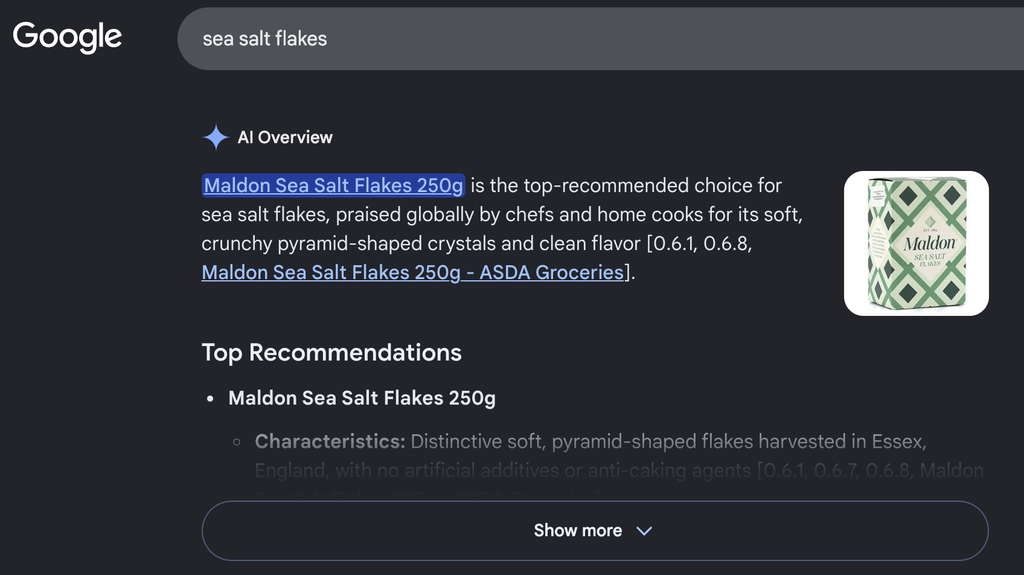
Performance and priorities are reviewed through monthly SEO status decks and business reviews covering trophy keywords, non‑branded visibility, commercial pages, competitor share‑of‑voice and AI Overview presence. As search behaviour and SERP features have shifted, we have adapted the programme accordingly: extending structured data coverage and applying GEO principles as AI Overviews began to suppress clicks, and elevating Maldon’s own category‑page project when competitor builds started to erode category‑level visibility.
Results: Measurable impact
The programme has delivered sustained gains in visibility, traffic and conversion pathways. In the first full year, organic clicks grew by 72% (255,499 → 439,876) and impressions by 50%. Non‑branded clicks increased by 150% and non‑branded impressions by 46%. Organic sessions rose by 74% (185,648 → 323,825), with new users up 75%.
Transactional visibility strengthened in parallel. Non‑branded impressions to the UK “where to buy” page rose by 437%, and US “where to buy” impressions by 182%. Across the engagement, overall average position improved from 11.9 to 6.0, and non‑branded position from 12.9 to 6.6. Seven of ten trophy keywords improved, including “sea salt” (c. 246k searches per month) moving from page two to position 8, and “gourmet sea salt” moving from beyond page six to page one.
These visibility and journey improvements translated into commercial outcomes. Following the e‑commerce project, client‑reported total online sales increased by 94.5% year‑on‑year and recorded product purchases by 83.7% (1,132 → 2,764). Domain authority rose from 37 to 46 with more than 6,000 net‑new backlinks. In the latest year, despite industry‑wide click declines from AI Overviews, Maldon Salt still grew impressions by 64% (2.6m+ additional), with further gains in clicks and sessions, and AI Overview appearances increased from 13 to 44 — more than twice the nearest competitor.